Every January, myself and millions of people set personal goals to lose weight, get healthier, or simply feel better than they did the year before.
Scammers know this. And they are increasingly exploiting that motivation with fake health endorsements for pills, powders, drops, and miracle cures that promise fast results with almost no effort.
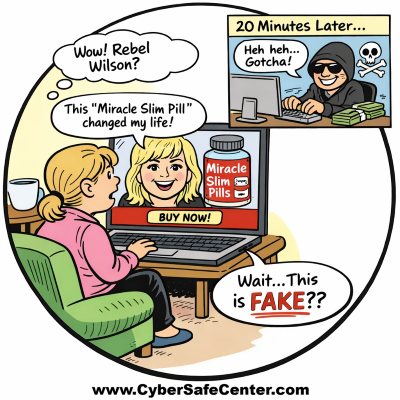
These scams often appear as slick videos on Instagram or Facebook. They look polished, professional, and emotionally convincing. A well known celebrity appears to share a personal story about struggling with weight or health and discovering a product that changed everything. Comments are filled with glowing testimonials. The video links to a simple checkout page. It all feels authentic.
Until it is not.
I recently fell into this exact trap. I clicked on a video linked from Instagram because I genuinely believed it was Rebel Wilson speaking candidly about her health journey. The video was long, nearly twenty minutes, and it felt personal and unscripted. I watched the entire thing. Only near the end did it become clear that something was off. The voice, expressions, and pacing were just slightly wrong. It was an AI generated video created to sell a completely worthless product.
I did not buy it, so I was lucky. But the experience was unsettling. Even someone who spends a lot of time thinking about online risk can be fooled when the content is well produced and targets an emotional goal like self improvement.
That is the real danger of these health scams. They are not clumsy pop ups or obvious spam emails. They are sophisticated, targeted, and designed to feel supportive and trustworthy. Scammers use AI generated video, cloned voices, and fake news style landing pages to create credibility. They prey on hope and urgency, especially in January when people are most motivated to change.
The products themselves are often useless at best and dangerous at worst. Many are unregulated supplements with vague ingredient lists and exaggerated claims. Some lead to recurring subscription charges that are hard to cancel. Others exist only to collect credit card information.
If you see a health endorsement video on social media, pause before you click or buy. Do not assume a familiar face means it is real. Look for independent reporting, search for the product name outside the platform, and be skeptical of any claim that sounds too easy or too fast.
Wanting to improve your health is not a weakness. But scammers are counting on that motivation. Staying cautious is one of the best self care decisions you can make this year.