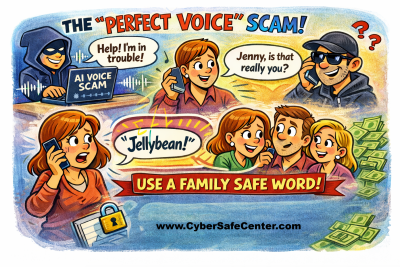
During a long holiday drive to see family, a familiar topic came up with one of our adult children. We revisited the family “safe word” we created when she was little. Back then, it was meant to confirm identity if a stranger ever claimed to be sent by us. Today, that same idea matters more than ever, but for a very different reason.
AI-powered voice scams, often called vishing, are evolving fast. Criminals can now clone a person’s voice using just a few seconds of audio pulled from social media videos like Instagram, voicemail greetings, or even short clips posted online. With that sample, they can create what sounds like a perfect copy of someone you trust.
The call usually starts with urgency. A family member is in trouble. A child has been arrested. A parent is in the hospital. Or in a work setting, it might sound like your boss asking for an immediate wire transfer or gift card purchase. The voice sounds right. The panic feels real. That emotional pressure is exactly what scammers rely on.
This is where the family safe word comes in.
A safe word is a shared secret that only trusted people know. It is never posted online and never used casually. If you receive a call that feels urgent, alarming, or just slightly off, you ask for the safe word. A legitimate caller will understand. A scammer will not have it.
This approach works well beyond families. Small teams, startups, and even close friend groups can use the same concept. It is especially useful for situations involving money, travel emergencies, or requests to bypass normal procedures.
A few tips for creating a good safe word:
- Choose something easy to remember but not easy to guess. Avoid names, birthdays, or anything tied to social media.
- Treat it like a password. Do not reuse it elsewhere.
- Practice using it. Talk through scenarios so it feels natural to ask.
- Update it if you think it has been exposed.
That holiday conversation reminded me that some of the simplest safety habits we teach kids still matter as adults. The threats have changed, but the solution is familiar. When technology can perfectly mimic a voice, trust needs a second layer. A shared secret might be the easiest and most effective one you can add.